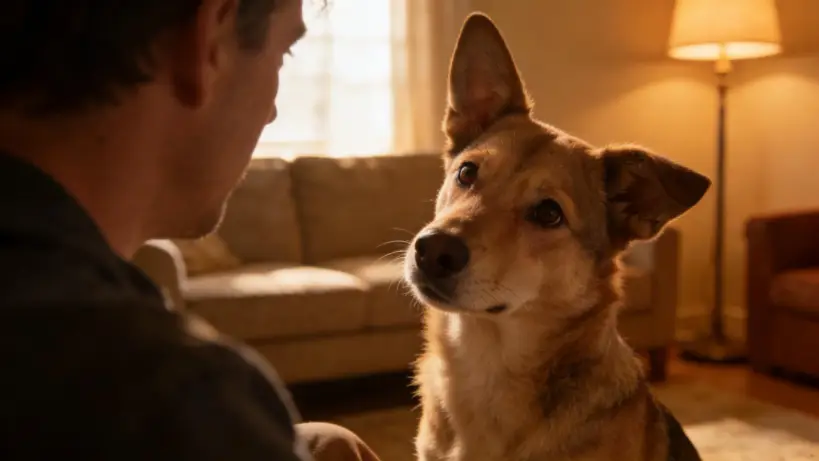
As beloved “fur babies” in countless American households, dogs often tilt their heads when we talk to them—like they’re hanging on every word.
They seem to listen intently, leaving many dog owners wondering: do they actually understand us, or just react to the sound of our voices?
In recent years, several ethology and neuroscience studies have revealed a heartwarming truth.
Dogs can not only grasp part of the meaning behind human language, but their approach to processing it is surprisingly similar to ours.
Every dog’s comprehension skills are unique, but this special cross-species bond never fails to warm our hearts.
It’s Not a Conditioned Reflex—It’s Real “Language Decoding”
Many people mistakenly assume dogs’ reactions to human language are just conditioned reflexes from years of training.
For instance, they get excited when they hear “walk” because they associate it with the joy of going outside—not because they understand the word itself.
But research shows the reality is far more fascinating than that.
fMRI scans from Hungary’s Eötvös Loránd University show that when dogs process human language, they activate the primary auditory cortex and caudate nucleus simultaneously.
This mirrors how humans process language, and increased activity in the caudate nucleus also links words to positive experiences for dogs.
What’s even more impressive: dogs can distinguish between word meaning and tone—just like human babies do.
They use their left brain to process the words themselves and their right brain to pick up on the emotions in our tone.
This dual processing method is one of the key ways humans make sense of language—and dogs do it too.
How Many “Human Words” Can They Remember? Individual Differences Are Clear

Every dog is one of a kind, and their ability to understand language varies quite a bit.
It largely depends on their breed, age, home environment, and how much training they’ve received.
Studies show the average family dog can understand 50 to 100 common words and gestures.
That’s roughly the language ability of a 2-year-old child; professionally trained Border Collies, however, can remember thousands of words.
They can even grasp simple grammar, showing off impressive language skills.
A comparative study from Duke University found that dogs are three times more sensitive to high-frequency human sounds than we are.
This lets them pick up on tiny changes in tone—even if you say “bad dog” in a soft voice, they’ll still feel your kindness.
More Than Listening to “Words”—They Understand Your Emotions

What makes dogs’ language processing so unique is that they don’t just fixate on the words themselves.
They’re better at combining nonverbal cues—your facial expressions, movements, even your breathing—to fully grasp what you mean.
A study from Emory University found that when owners cry, the parts of dogs’ brains linked to empathy light up.
Most dogs will comfort you by licking your hand or snuggling up—and this ability to empathize is key to how they understand us.
As many American dog owners know, if you say “it’s okay” in a helpless tone.
Your dog will lie quietly at your feet—they don’t get abstract emotional words, but they can sense when you’re feeling down.
How to “Communicate” More Effectively with Your Dog?
Once you understand how dogs process language, you can communicate with them in a way that strengthens your special bond.
First, stick to simple short sentences and a consistent tone—avoid long, complicated phrases.
This makes it easier for your dog to catch key words and figure out what you’re trying to say.
Second, pair key words with specific actions—like tapping the food bowl when you say “dinner.”
After a few repetitions, your dog will quickly make the connection between the word and the action.
Also, make sure your words match your actions—confusion will only stress out your dog.
Most importantly, honor each dog’s uniqueness.
Some dogs are sound-sensitive and pick up on language easily; others rely more on body language to understand you.
Don’t hold them to the same standard—give them plenty of patience and grace as they learn.
Conclusion: Listen to Their “Responses” and Prioritize Professional Care
Dogs might not understand complex language like we do, but they work hard to decode every word we say in their own way.
They also try to understand every emotion we feel—and this bond, forged over 15,000 years of coexistence.
Is the best proof of their love for us, warming every pet-loving home.
Keep in mind: if your dog suddenly becomes unresponsive to language, stops listening, or acts out of the ordinary.
It’s best to consult a professional veterinarian right away to rule out any underlying health issues.
Professional diagnosis, treatment, and care will help keep the communication between you and your fur baby strong for years to come.